
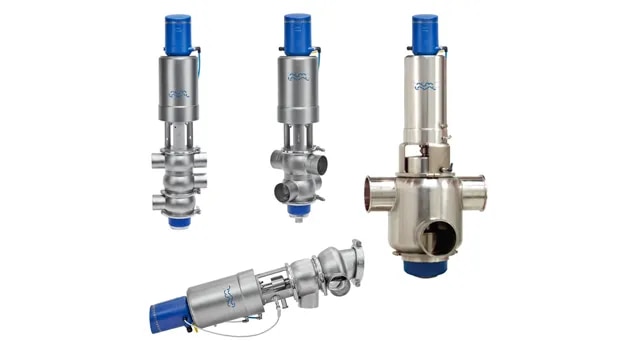
Double seat valves
Description
Modular and versatile, Alfa Laval mixproof valves are double block and bleed valves that handle the simultaneous flow of two different products or fluids through the same valve at critical pipeline junctions without the risk of cross-contamination. These Alfa Laval double seat valves provide exceptional operation, enhanced cleanability and high customizability to meet any hygienic process requirement. What you get is more uptime and the lowest total cost of ownership.
Double Seat Valves
Safe, efficient, hygienic handling of two fluids through the same valve without the risk of cross-contamination
Maximum product safety, minimized risk of cross-contamination
Enhanced product yield due to cost-effective, spillage-free operation
Optimized plant efficiency and enhanced cleanability
More uptime due to spillage-free design with double lip seal, built-in leakage detection and leakage chamber
Fully configurable with a broad range of models and options to meet virtually any hygienic processing requirement
Rely on Alfa Laval double seat valves for more uptime, greater flexibility, reliable operation, optimized maintenance, and easy cleanability. Select only for the features and functionality you require now; modularity lets you easily upgrade the valves to meet your changing needs. Plus enjoy an exceptional service life and reduced utility costs from each of Alfa Laval mixproof valve. Hygienic, high purity, aseptic and specialized versions are available for use across the dairy, food, beverage, home-personal care, and biotech and pharmaceutical industries. To better manage your mixproof valves, pair them with Alfa Laval sensing and control units.
How do double seat valves work?
The Alfa Laval double seat valve is a normally closed (NC) valve controlled from a remote location by means of compressed air. The double block and bleed valves has two independent plugs and seals to separate the flow of liquids and prevent cross-contamination; the space between the seals forms a leakage chamber at atmospheric pressure during every working condition. In the rare event that leakage may occur, product flows into the leakage chamber and exits through the bottom outlet for easy detection. When the valve is open, the leakage chamber is closed. The product then flows from one line to the other.